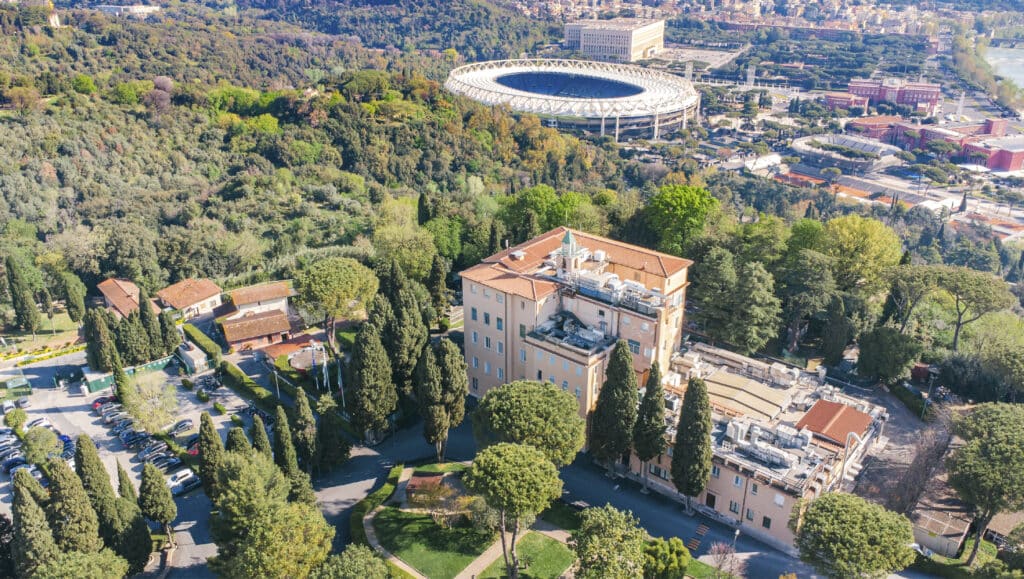
At Villa Stuart, care is understood as a pathway built around the individual, capable of integrating specialist expertise, rehabilitation, prevention, and innovation. It is a model that accompanies the patient through the various stages, from the initial evaluation to functional recovery, with a personalized and multidisciplinary approach.
The following article, published in the September issue 064 of Stil’è – L’arte di vivere il bello, describes the Villa Stuart model through its main areas of intervention, exploring the value of continuity of care, specialization, and innovation applied to treatment.
The September 2026 publication in Stil’è – L’arte di vivere il bello
The Villa Stuart care pathway
In Rome, Villa Stuart has always represented a point of reference for sports medicine and orthopedic excellence. A FIFA Medical Centre of Excellence and a reference center for numerous professional athletes, over the years it has expanded its mission by placing the same expertise at the service of patients of all ages united by a common objective: to recover mobility, autonomy, and quality of life.
“Our clinic is known in the world of sport, but the majority of patients we assist are not professional athletes,” explains Director Santini. “Our task is to combine the best medical expertise with the needs of the individual, accompanying them toward the recovery of the best possible condition.”

Prosthetic surgery: a choice built around the patient
Prosthetic surgery represents one of the areas of greatest specialization of the facility, with particular experience in hip, knee, shoulder, elbow, and ankle prostheses. However, surgical intervention is not considered an automatic response. “The surgical indication is formulated only after a careful clinical evaluation and after having taken into consideration, when possible, all conservative therapeutic options,” emphasizes Santini.
A personalized care pathway: rehabilitation and continuity of care
A distinctive element of Villa Stuart is the personalized care pathway. Every joint issue is entrusted to dedicated specialists and integrated into a program built around the characteristics and
objectives of the individual patient. Rehabilitation begins during the hospital stay and continues through physiotherapy at the clinic and at home, hydrokinesiotherapy, and medical fitness programs, ensuring continuity of care even after returning home.
The Villa Stuart multidisciplinary approach
At the foundation of this model lies a consolidated multidisciplinary approach. Orthopedists, physiatrists, internists, physiotherapists, and rehabilitation professionals collaborate constantly to define shared therapeutic strategies and pathways calibrated to individual needs. A method developed within the field of sports medicine and today successfully applied to all categories of patients.
Particular attention is also dedicated to prevention and functional longevity: early detection of joint pathologies often means preserving quality of life and autonomy for longer.
Research, innovation, and artificial intelligence
Looking to the future, Villa Stuart aims to strengthen its role as a center of excellence by investing in scientific research, academic collaborations, and technological innovation. Among the tools intended to support clinical activity is also artificial intelligence, employed as an aid to decision-making processes through the analysis of large quantities of data.
“Artificial intelligence does not replace the physician – concludes Santini – but it can support them in identifying the most appropriate choice, contributing to improving the quality of clinical decisions and care pathways.”
The Villa Stuart Model
In the Villa Stuart model, care translates into a pathway that accompanies the patient beyond the individual treatment, linking specialist evaluation, intervention, rehabilitation, and functional recovery.
It is a vision that combines multidisciplinary expertise, personalization, and continuity of care, with an increasing focus on prevention and innovation. The objective is to build care pathways that are ever closer to the needs of the individual, capable of looking not only at the resolution of the problem, but also at quality of life and long-term well-being.
Browse the September 2026 issue: the Stil’è – L’arte di vivere il bello article is available here.


